Accepted to SIGGRAPH Asia 2026 (ACM ToG)
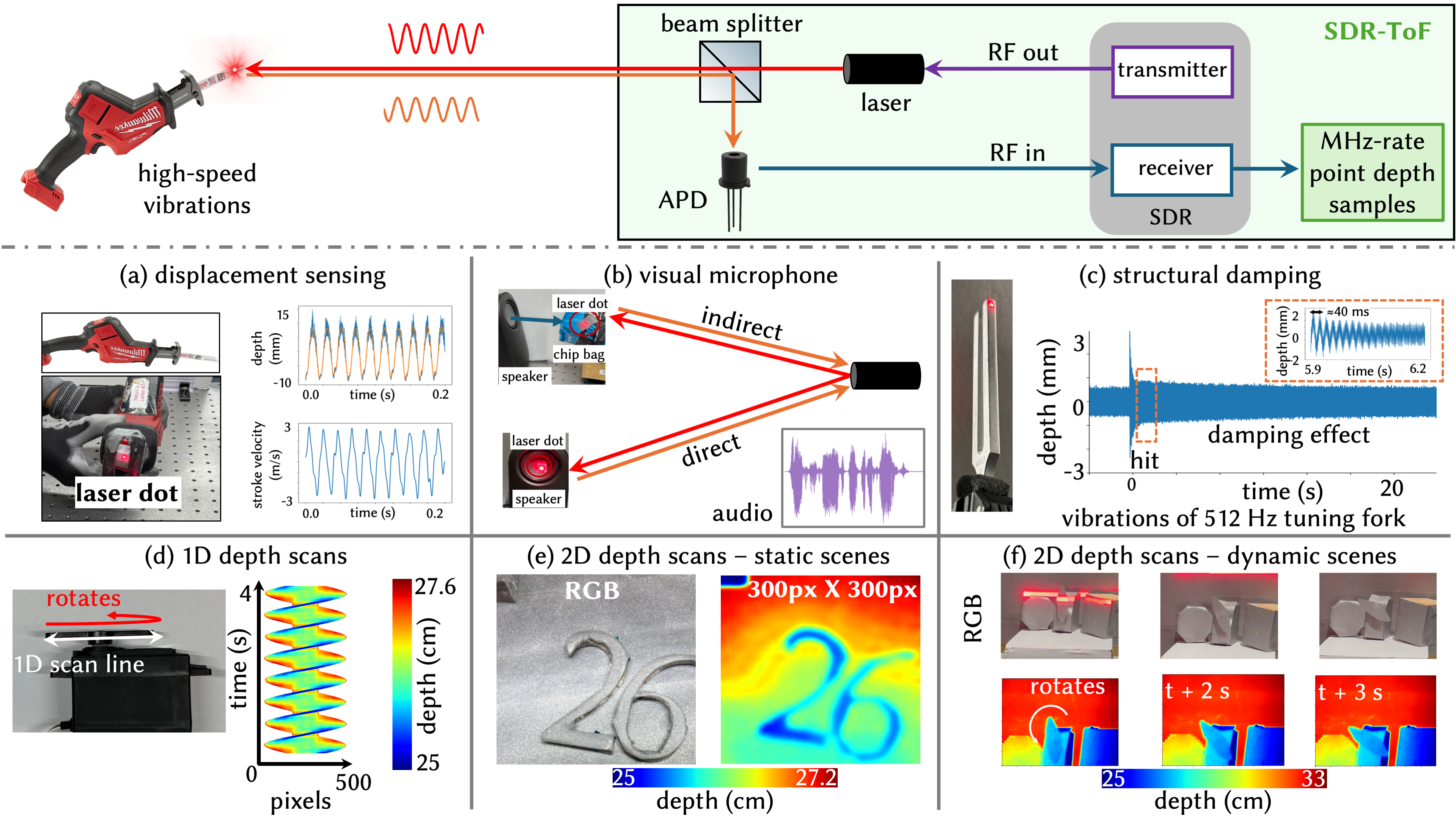
We present a continuous-wave time-of-flight CW-ToF sensing system capable of megahertz-rate depth measurements using a free-space laser and commodity radio-frequency (RF) communication hardware. Existing high-speed optical displacement and vibration sensing systems typically rely on optical interferometry or specialized heterodyne electronics, making them complex and expensive to deploy. We instead show that commodity software-defined radios (SDRs) can serve as a programmable optical sensing backend by jointly performing laser modulation and RF demodulation of signals measured by a fast photodiode. This architecture enables direct phase-based depth estimation at megahertz temporal rates without requiring optical interferometry. Because both the modulation frequency and readout pipeline are fully programmable in software, the system allows flexible trade-offs between depth range, precision, and temporal bandwidth. The resulting sensor supports high-speed depth and vibration measurements, enabling applications such as monitoring rapidly moving mechanical systems, and reconstructing acoustic signals from vibrating surfaces. We experimentally evaluate a prototype system across multiple sensing scenarios and demonstrate sub-millimeter depth sensitivity at megahertz sampling rates, while analyzing practical limitations including noise, drift, and hardware constraints. Our results show that commodity RF hardware can enable low-cost, high-speed optical depth sensing, opening new opportunities for computational imaging and dynamic scene analysis.
This work was supported by the NSF under grants CCF-2403122, CCF-2326904, and CCF-2326905. GPU support for this research was partially provided by ASU Research Computing through the Sol supercomputer SOL. We thank Prof. Timothy Pierson, Cesar Arguello, and Ravindra Mangar for their support with the software-defined radio and USRP hardware, and Prof. Eric Fossum and Prof. Jifeng Liu for their help with optics and electronics. We used large language models for copyediting and paraphrasing during manuscript preparation.
@article{bhaskara2026sdrtof,
title = {SDR-ToF: Million Optical Depth Samples per Second Using Software-Defined Radio},
author = {Bhaskara, Ramchander and Sirikonda, Dhawal and Vengurlekar, Omkar and Kim, Juhyeon and Lazarro, Joseph and Jayasuriya, Suren and Pediredla, Adithya},
journal = {ACM Transactions on Graphics (TOG)},
year = {2026},
volume = {45},
number = {6},
articleno = {224},
doi = {10.1145/3842565}
}